


If you’ve been burned by an SEO agency before, this guide is for you. It’s not here to teach you how to do SEO yourself (though it’s detailed enough that you could). It’s here to show you what real SEO looks like, so you know what you should be getting, and can spot the difference between an agency that knows their stuff and one that’s just taking your money.
1. What does SEO mean to plumbers?
The difference in SEO between one agency to the next is like the difference between me duct taping a pipe and calling myself a plumber. So let’s break down what you should actually be looking for, and how to know if an agency can deliver it.
So let’s break it down in terms of what you should be looking for, then how to know if they’re capable of delivering it.
First, let’s define it: SEO stands for Search Engine Optimization. Basically, doing things search engines like so you get more traffic from them.
For plumbers, that mainly means showing up in two places: the map pack and the organic results:
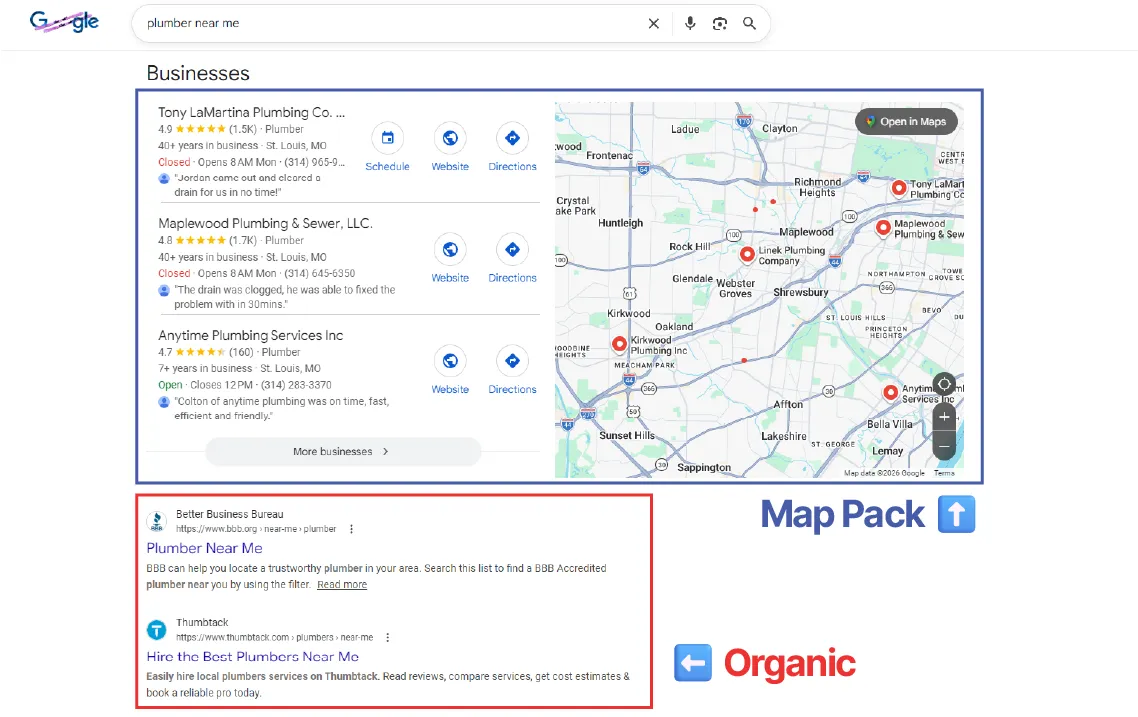
The goal? Rank highly when people in your area search for a plumber. If you can rank (and not everyone can - there are only 3 spots in the map pack), the next goal is converting those clicks into calls and contacts.
So more leads, in a nutshell.
But not all leads are created equal. Here’s why SEO leads are better than almost any other marketing channel:
- They’re actively searching for a solution: It’s not brandvertising, they searched because they have a problem they found you, and they contacted you
- They’re exclusive: Not a race between 5 companies to contact them first, they specifically contacted you
- You own the data: They contacted you via your form or your phone, you can ask and collect any information that you like
- You control the framing: It’s your website, your design, your content, your imagery, your branding, everything that you selected to represent your business in the way you want it shown
And it’s not feast or famine. There’s no hit or miss like an advertising campaign or a radio run. People in your area have a plumbing problem every single day, and when they search, they either find you or they don’t. They either pick you first, or they don’t. But they still search, they still contact someone, and they still pay someone.
2. Where SEO fits into your overall marketing strategy
“If all you have is a hammer, everything looks like a nail.”
Ask a social media agency what you need, they’ll say social media. Ask a direct mail company, they’ll say direct mail. Ask an SEO agency, they’ll say SEO.
So let me be upfront: we’re an SEO agency. But before you assume I’m about to tell you SEO is the only thing that matters, hear me out.
I’ve been doing digital marketing for over a decade. I built my first business at 17 using affiliate marketing and paid ads - we did $300k in year one. I’ve run viral social media pages (one hit 7 million fans), managed email lists with 100k+ subscribers, and spent hundreds of thousands of my own money testing what actually works.
I’m telling you this not to brag, but to make a point: I’ve tried everything, and I still think for plumbers specifically, SEO should be your foundation. Not your only strategy, but a key part of it.
Here’s how it all fits together:
SEO is the foundation. Map Pack first, then organic.
When someone’s pipe bursts at 2am, they’re Googling “emergency plumber near me” right then. They need help NOW, and they’re going to call whoever shows up first. It’s direct response, people searching because they need a plumber immediately.
SEO takes 3-6 months to build momentum, but once it’s working, it’s the highest ROI channel you’ll ever have. You’re not paying per click, and the leads keep coming month after month.
Google Search Ads parallels this.
While SEO takes 3-6 months to really kick in, ads can have your phone ringing tomorrow. Plus, even when you’re ranking #1 organically, running ads lets you dominate even more of that search results page. More visibility = more calls = more revenue.
The tradeoff? It costs per click, so the ROI will never match SEO. But for speed and control, it’s unbeatable.
Paid Leads Services are optional addons.
You only pay when you get a lead, which is nice. But you have zero control: they can raise prices, change terms, or send you junk leads. Plus, you’re often competing with 3-4 other plumbers for the same lead, so they don’t convert nearly as well.
Use them if you want supplementary volume, but don’t build your business on them.
Social Media is for the long-term.
The dream? Someone needs a plumber and thinks of your business first without even Googling. That’s brand awareness, and social media can absolutely build it, especially if you’re running ads to amplify your content.
But it takes years. Realistically, you’ll spend 2-3 years posting consistently before you might see meaningful brand recognition in your area. Meanwhile, SEO and ads are capturing people who need a plumber right now. And all those customers, their neighbors and friends, who do you think they’ll call next time they need a plumber?
So if you have the resources, do your daily posts across the social media platforms. But don’t make it your priority when there are people Googling for plumbers every single day who could be calling you instead of your competitors.
Facebook & Instagram Ads are hit-or-miss for plumbers.
Unlike Google Ads where people are actively searching for a plumber, Facebook and Instagram ads interrupt people while they’re scrolling. You’re reaching them before they need you, which means lower intent, longer sales cycles, and harder-to-track ROI.
That said, they can work for brand awareness in your service area, promoting specific offers, or retargeting people who visited your website but didn’t call.
If you’ve got budget left over after Google Ads and want to experiment, go for it. But it’s a lower priority after maximizing Google search customers.
The bottom line is this:
Build an incredibly good website, every channel relies on this (except paid leads, but even then, people will look you up).
Run SEO and Google Ads in parallel. If you’re budget-constrained but otherwise busy with work, prioritize SEO for higher ROI. If you’re a startup than needs leads yesterday, prioritize ads for faster growth. Everyone else? Run both indefinitely, or until ads becomes prohibitively expensive.
Want more volume? Add paid lead services for supplementary leads, just don’t rely on them as your foundation.
Got extra budget and want to experiment? Test Facebook/Instagram ads. Connect your retargeting pixel to reach people who visited your website but didn’t call, ideally with some kind of offer or promotion to give them a reason to act now.
And if you’ve got even more resources and are committed for the long haul? Post daily on social media for years to build real brand presence in your area. This isn’t a side project, it requires serious commitment, consistency, and the ability to create genuinely interesting content. But if you can pull it off, it compounds over time.
3. Plumbing Keywords
Before you build a single landing page, run a single ad, or write a single word of content, you need to know what you’re targeting. That’s what keyword research is. And done properly, it’s the foundation everything else is built on.
Most plumbers skip this step, or worse, guess. They assume they know what people search for. And they’re usually mostly right, but mostly right means you’re missing a chunk of searches that could be sending you 2-3x the lead volume.
So let’s do it properly.
3.1. What keywords actually matter for plumbers
There are two types of keywords that matter for your business: service keywords and location keywords. Everything else is secondary.
Service keywords are what people search when they need a plumber. These break down into two categories:
Generic plumbing keywords. These are broad searches like “plumber near me”, “emergency plumber”, or “plumber”. High volume, high intent, and highly competitive. Everyone is targeting these. You should too, but don’t stop here.
Specific service keywords. These are searches like “water heater repair”, “drain cleaning”, “sewer line replacement”, “burst pipe repair”, or “toilet installation”. Lower individual volume, but there are dozens of them. Added together, they often exceed the generic terms. And they convert better too, because someone searching “water heater replacement cost” knows exactly what they need.
Location keywords are the modifier that makes all of this relevant to your business. “Plumber” is useless on its own. “Plumber Tampa FL” is a lead waiting to happen.
The goal is combining these two. Service plus location. That’s the formula.
3.2. Building your keyword list
Start with your services. Write down every single thing you do. Not just the broad categories, but the specifics:
- Plumbing (general)
- Emergency plumbing
- Water heater repair
- Water heater replacement
- Water heater installation
- Drain cleaning
- Drain repair
- Sewer line repair
- Sewer line replacement
- Pipe repair
- Pipe replacement
- Leak detection
- Toilet repair
- Toilet installation
- Faucet repair
- Faucet installation
- Garbage disposal
- Water softeners
- Repiping
- Gas lines
That’s not an exhaustive list, it’s a starting point. Your list will look different depending on what you offer. The point is to be thorough. Don’t just write “drains” when you actually offer drain cleaning, drain repair, hydro jetting, and camera inspections. Each of those is a separate keyword, a separate search, and potentially a separate landing page.
Now do the same for your locations. Your primary city first, then every suburb, neighboring town, and area you realistically serve. If you’re based in Tampa, that might mean Brandon, Clearwater, St. Petersburg, Wesley Chapel, Land O’ Lakes, Lutz, Riverview, Valrico, Ruskin, Apollo Beach, and more. Write them all down.
Now combine them. Water heater repair Tampa. Drain cleaning Tampa. Emergency plumber Tampa. Emergency plumber Lutz. Emergency Plumber Clearwater. That list is your keywords.
3.3. Validating with search volume
Your instincts will get you 80% of the way there. But keyword research tools will close the gap and often surface searches you’d never have thought of.
Any reputable keyword research tool will do. They all pull from similar data sources and the differences at this level are minor. What you’re looking for is search volume and who’s actually ranking.
Search volume tells you how many times per month people search that term. For local plumbing keywords, don’t expect thousands. A term like “plumber Tampa” might get a few hundred searches a month. That sounds low until you realize those are people actively looking for a plumber right now, and a decent ranking can send a meaningful percentage of them straight to your phone.
A quick note on accuracy: keyword tool search volumes are estimates, and for local searches they’re often understated. The actual traffic from a well-ranked local keyword is frequently higher than the tool suggests. Use the numbers for comparison and prioritization, not as gospel.
3.4. Understanding the competition
Most keyword tools will show you a “keyword difficulty” score. Ignore it, or at least don’t rely on it. They’re often wrong, and they’ll either scare you off keywords you could actually rank for, or give you false confidence on ones you can’t.
Here’s what to do instead: look at who’s actually ranking.
Search your target keyword and look at the organic results. Most keyword tools will show you the Domain Rating (DR), Domain Authority (DA), or whatever their equivalent authority score is for each page currently ranking. That number reflects how strong that website is, built up over time through links, trust, and history. It’s a much more honest signal of what you’re up against.
If you pull up the results and see a handful of local plumbers sitting there with DR 15, DR 22, DR 18 — that’s a wide open keyword. Those are sites you can outrank. Maybe not tomorrow, but with a decent website and a bit of link building, absolutely.
3.5. Intent matters more than volume
Here’s something most keyword guides won’t tell you: a keyword with lower search volume and clearer intent is often worth more than a high volume keyword with ambiguous intent.
Take “plumber” versus “emergency plumber near me”. The first one gets more searches. The second one is someone with a flooded bathroom at 11pm who is calling the first number they see. Which lead do you want?
For plumbers specifically, intent breaks into three buckets:
Immediate need. Emergency plumber, burst pipe, flooded bathroom, no hot water. These people need someone right now. Highest intent, fastest to convert, worth targeting aggressively.
Planned work. Water heater replacement, bathroom remodel plumbing, repipe house. These people are shopping around. Still high value, but a longer sales cycle. Your content needs to do more work to win them.
Research phase. How much does a plumber cost, how to unclog a drain, why is my water pressure low. Lower intent, but not worthless. Someone researching a problem today might need a plumber tomorrow. This is where blogging comes in, covered in section 9.
Build your keyword strategy around the first two.
3.6. A note on “near me” keywords
“Plumber near me” is one of the most searched plumbing terms in almost every market. And you might be wondering: how do I target that?
You don’t need to. Google knows where the searcher is. When someone in Tampa searches “plumber near me”, Google serves them Tampa plumbers. Your job is to rank well in Tampa, then you’ll capture those searches automatically.
3.7. Prioritizing what to go after first
You now have a long list. You can’t target everything at once, so here’s how to think about prioritization:
Start with your primary city and your most common services. “Plumber Tampa FL”, “emergency plumber Tampa”, and your top two or three services in that city. These are the highest value, most searched, and what you most want to rank for.
Then expand outward. More services in your primary city, then your primary services in surrounding locations.
4. SERP Locations
Search results are complicated. What used to be organic (i.e. unpaid pages ranked using algorithms) and ads (i.e. paid positions) has morphed into several types of search results or locations.
An ideal strategy would be to target each of these. That is also our preferred strategy. But first you need to understand what these are, and for a newer business with less resources, how you may want to prioritize if you must.
4.1. Ads
Ads are the paid results, usually at the top of the SERPs (search engine results page). For the purposes of this guide, we will specifically focus on Google Search Ads, though Bing and other platforms are similar. Our reasoning is simple, Google is a monopoly so that there’s little sense targeting others until you have maximized it.
Search Ads work on a pay-per-click auction model. That means you set a maximum bid for every click of your ad, then you compete to bid the highest against competitors. The ad with the combination of the highest bid and most relevance to the user will be shown nearest the top, therefore getting the most clicks, and making the search engine the most money.
This is a fantastic model for plumbers. Unlike traditional media advertising, you only pay when someone clicks your ad. And targeting allows you to reach people searching extremely specific queries. As a result, you can very quickly become profitable with this by simply targeting people looking for plumbers, having a high converting website (5% minimum), and simply turning on well-targeted ads.
By far the fastest way to generate high quality leads is through ads. The only risk is competitors with deeper pockets or higher margins who can simply outspend you. In that case, you may not be able to compete.
Still, if you have the budget. Test ads first.
4.2. Local Service Ads
LSAs are technically ads, but they deserve their own section.
It’s a separate Google platform where you pay per lead, not per click. They show up above even regular ads in a “Google Guaranteed” section on certain searches:
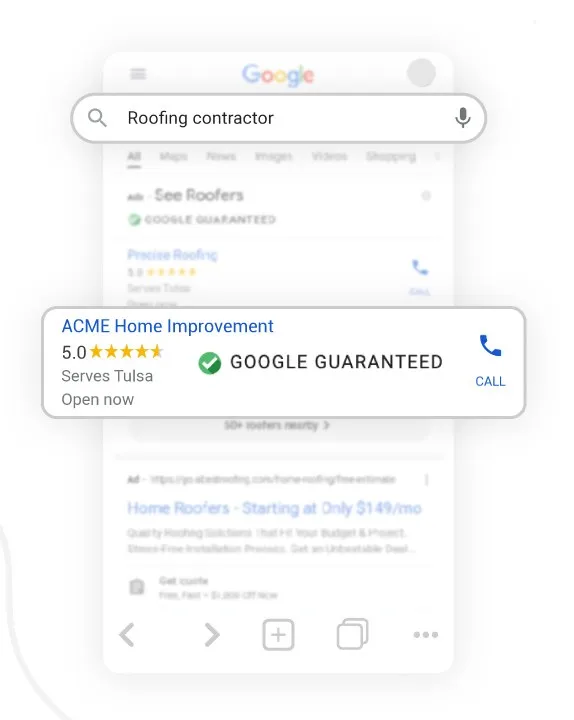
And they’re absurdly simple to set up. Select your category (“Plumber”), choose your service areas, set a monthly lead budget, and you’re done. You only pay when you actually receive a lead. No clicks, no wasted spend.
Most plumbers aren’t running them. That’s your opportunity.
The only real requirements are proof of insurance and an active Google Business Profile. Both of which you should already have. If you don’t, sort that first.
4.3. Google Maps
If there’s one section in this entire guide you actually act on, make it this one.
Map results, specifically the map pack that shows up in regular Google searches for local businesses, drives more clicks and calls per search than anything else. Yes, ads might show more trackable leads because the targeting is broader and the attribution is cleaner. But when someone searches “plumber near me” and sees three businesses on a map with reviews and a phone number? That’s where the calls come from.
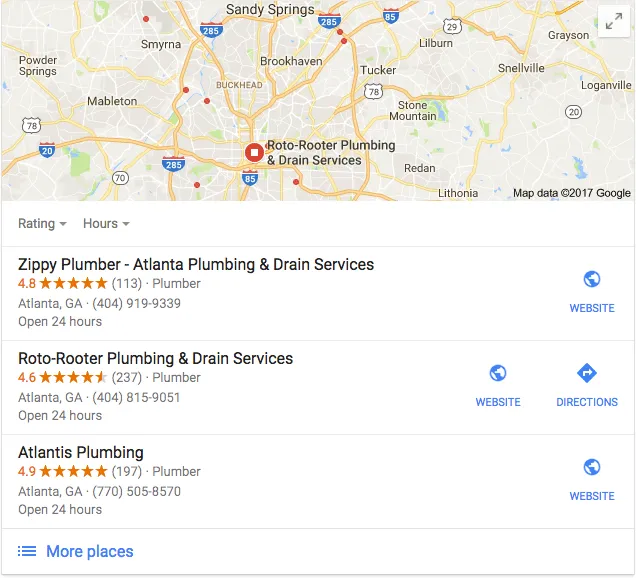
Do not skip this. Do not delay it. If your Google Business Profile isn’t set up and optimized, stop reading this guide right now and go do that first. We have a full guide here.
Done? Good. Now treat it like the asset it is. Request reviews from every customer. Post updates. Add photos. Stay active.
If you’ve accepted that search is the best channel for plumbers, and it is, then the map pack is where that belief needs to show up in your actions.
4.4. Organic
Organic results are the classic unpaid listing. No bidding, no budget, just pages Google decided were worth showing. They sit below the ads, below Google Guaranteed, and below the map pack. You already know how far down that is.
And yet. People still click them. A lot.
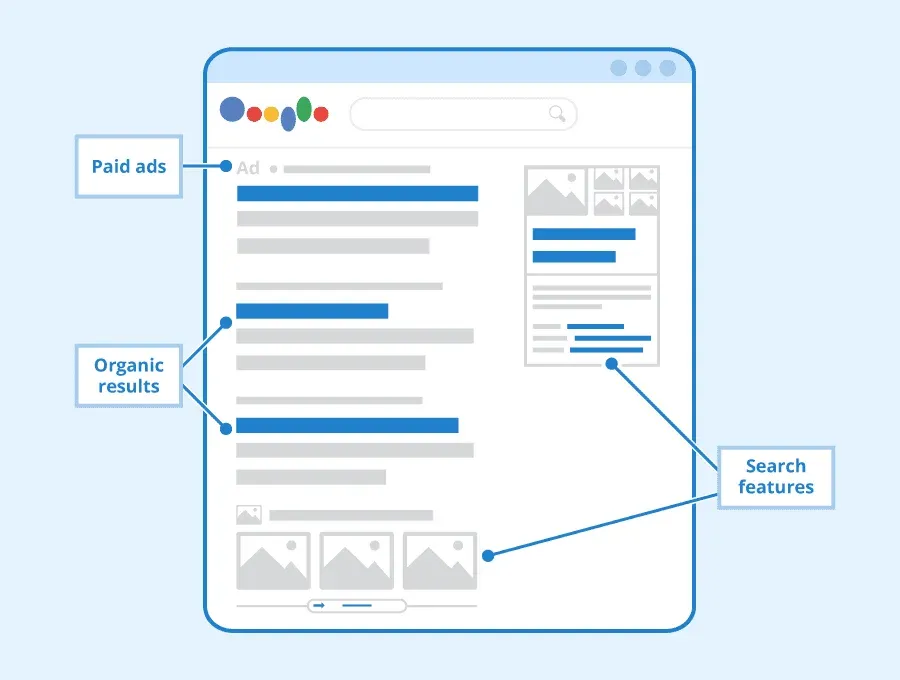
Not as many as the map pack, but more than enough to justify the effort. Especially when you consider that organic costs you nothing per click, just time, or an agency’s time. The cost-per-lead ends up significantly lower than ads, and you’ll likely pull in dozens of leads a month from it once you’re ranking well.
But here’s the angle most agencies won’t tell you, because frankly most of them don’t think this way: organic SEO makes everything else work better.
Better SEO means higher relevancy scores, which means cheaper clicks and higher placements in your ads. Better organic rankings feed better map pack rankings. It’s all connected. So yes, do SEO because it’ll get you more leads. But do it also because it quietly makes every other dollar you spend on search more profitable.
5. Landing Pages
If your keyword selection followed our earlier strategy, you’ve likely come up with several target locations and possibly even service names too. But how do you target each of these locations? A single page that says “and the greater [location] area”? Heck no.
You need landing pages. Others may call them location pages, but it’s important to differentiate. Landing pages can be locations or services (or both), and are specifically designed to be landed on first. They’re not informing of a location you cover. They are specifically targeting people within that location, who you are, what you do, and why they should contact you. The difference here is a page that converts 1% vs 8% of visitors into leads.
For organic results, landing pages are a necessity. Without a page specifically optimised for each topic of keywords, it will be impossible to rank for all. The good news is you’ll need them anyway. Ads perform better with landing pages. Map results convert better too (albeit for services not locations).
So let’s walk through how to set them up and use them.
5.1. Keyword-strategy
Not every keyword needs a separate landing page. But every unique topic does. This is ridiculously confusing for any sane person that does not spend 16 hours a day sifting through keyword research spreadsheets, so let me explain:
Keywords are search queries. This could be plumber near me, plumber san antonio tx, plumbers in san antonio tx, emergency plumber san antonio tx, best plumber san antonio, or specific services like water heaters or drain cleaning.
Topics are groupings of keywords that essentially mean the same thing. Some are obvious such as “plumber san antonio tx” is near identical to “plumbers in san antonio tx”. Others are less clear, “plumber near me” and “plumber san antonio tx”, for example, are identical for all intents and purposes if the person is located in San Antonio.
The simplest strategy here is each location and each service is a separate topic. And if you decide to have each service for each location (e.g. “drain cleaning [location]” for each), they are also separate topics, though that strategy may not be ideal and should be considered (see 5.3).
The simplest gut-check is to simply search both variations and verify. If the same webpages are ranking in both organically, then you can do the same. And if it’s split, then you decide, both seemingly work.
5.2. Location based landers
The first landing pages to build are location-based. Rather than relying solely on your homepage to target “Plumbers San Antonio”, you add dedicated pages for every area you serve:
- Saint Hedwig
- Marion
- Seguin
- Canyon Lake
- Spring Branch
- Kendalia
- Bergheim
- Comfort
Here’s the blunt truth: without these pages, you don’t exist in those searches. Google isn’t going to assume your San Antonio homepage is relevant to someone searching for a plumber in Canyon Lake. You either have a page targeting that area, or you don’t rank there. It’s that simple.
And every page you add is another entry point. Ten location pages means ten more chances to rank, ten more searches where you show up instead of a competitor who bothered to build them and you didn’t.
It’s also just genuinely useful for visitors. Someone in Seguin doesn’t want to land on a page aimed at people three cities over. A dedicated page that speaks directly to them. Your coverage of their area, your response times, why you’re the right call. This converts better for organic and ads.
We’ll cover content and structure in section 6. But the short version: put real effort in. Write something unique for each location. Use a photo of your truck in their area, or the team that covers it. Don’t just clone another page and swap the location name. Google will notice, and so will your visitors.
5.3. Service based landers
Similar to locations, you’ll want landing pages for each of your services too. Offer water heater services? Drainage? Sewer repairs? Whatever it is, create a dedicated page just to highlight it.
Same rules apply. If you don’t have it, and someone does search it - and I can tell you right now, they do - then you will not rank. You will not even exist.
So think about your services. Do you offer water heater repair? Replacement? Installation? Maintenance? Each of these are separate services and should be separate landing pages.
This isn’t only an SEO strategy. It’s good business. Show your potential customers what services you offer, how you solve their problems, your specific approach, etc. This establishes trust. Or frankly, just knowledge that “they do actually offer what I need without having to call 5 different companies”.
Now in terms of locations, this is where it can get more advanced.
By default, every service page should target your broadest location. “Water Heater Repair San Antonio, TX” in our example. Biggest population, most searches, most value.
Should you combine this with 5.2 and create pages like “Water Heater Repair in Marion”? Probably not, and for two reasons. First, the search volume for that specific combination is usually too low to justify it. Second - and this is the part most people miss - you can often rank for it anyway. If nobody else has built that page either, your general service page or location page might rank by default. So why risk looking spammy when you might get the result without trying?
The exception is if a specific service in a specific location is genuinely important to your business. In that case, build the page. But treat it as a deliberate decision, not a default strategy.
6. OnPage & Content
This section is the meat of this guide. All of the keyword research, the landing page planning, all of that is cumulated into the strategies you’ll learn here to actually create pages that rank.
6.1. Page Structure
Landing pages should follow specific structures to perform best. They may look different, follow different brand guidelines, but at the end of the day the SEO fundamentals are always the same.
- URL: Use the location name in the URL (e.g. /marion). There is no need for the service combined (e.g. /plumbers-marion), but this is okay and can help if not overdone. Shorter is better. Services should be /service-name.
- Title Tag: The page title is in code, not what you see on the website, ask your developer. This should contain the Service Name and Location (main location if a service page). Brand name is unneeded here as Google will know it already. No need to overthink it even “Water Heater Repair In Chicago, IL” works.
- Meta Description: This is the description that shows in the Google Search Results for organic listings. Just say what you do and who you help, specific to the page you are on.
- H1: The Heading 1 is the main heading on the page and sets the topic for a page. Firstly, make sure it is set to H1 in the code, it’s important. Besides that, again, repeat the main keyword (service + location).
- H2s & H3s: Heading 2s are your subheadings that fit with your H1, H3s are subheading within H2s. Use these naturally, but if you can squeeze in alternate phrasing or terms for your services, and the location name again - do that, it helps.
- FAQs: While not technically an element, it is worth specifically mentioning as FAQs are a great way to add extra content without stuffing up the page. Use them near the bottom to answer genuine customer questions. Use faqpage schema, though Google reportedly do not read this anymore.
- Call to action: Always, always include extremely clear call-to-actions on your landing pages. That means either a huge button or an actual embedded form to submit. As well as phone numbers. If someone can’t find either of these within a second of looking at your website, you’ve failed.
Most landing pages can follow a rather standard structure:
H1: [Service] in [Location]
Paragraph: Short intro in your brands voice with what you do and who for
Button: Contact/get a quote/whatever you want to say
(Or this again, but on the right, there’s an embedded form they can submit instantly to contact you, no extra steps)
Badges: Insurance, Reviews, or other credibility signals
H2: [Service] Services in [Location] List: Services (linked if applicable)
H2: Why choose [company]? List: Benefits or USPs
H2/paragraphs explaining service more if needed.
H2: [Location] reviews Cards: Selected reviews from this location
H2: [Location or Service] FAQs H3: Question name Paragraph: Answer
H2: Serving [Broad Location Name] List: Link to location pages
6.2. Writing the Content
Most plumbing websites read like they were written by a robot, reviewed by a lawyer, and approved by nobody who has ever actually spoken to a customer. Passive voice, generic claims, zero personality. “We are a trusted local plumbing company serving the greater Tampa area with over 20 years of combined experience.” Nobody believes that. Nobody remembers it. And Google isn’t impressed by it either.
So write like a human being.
Tell people who you are. Not your company registration number, not your service radius - who you actually are. Are you a family business? Say that. Did you start this company because you got sick of working for someone who cut corners? Say that too. People hire plumbers they trust, and trust comes from feeling like there’s a real person on the other end of the phone.
Here’s a rough guide for what each page should cover:
For location pages: Lead with who you are and that you serve this specific area. Not “the greater Tampa area and surrounding communities”, the actual town. Then cover what you offer, why you’re the right call, and make it easy to contact you. If you have a team member or truck that specifically covers that area, mention it. A photo of your van in Brandon hits differently than a stock photo of a wrench.
For service pages: Lead with the problem, not the service. Someone searching “water heater repair” already knows what they need. Acknowledge that, explain how you handle it, what the process looks like, roughly what to expect. Then make it easy to contact you.
On length: There is no magic word count. Answer the question, cover the topic, don’t pad it out. Most landing pages need 300-600 words to do the job properly. Some services warrant more if the topic is genuinely complex. Stop when you’ve said what needs to be said.
On AI: Use it if you want, but don’t one-shot it. AI writes in the same bland corporate voice you’re trying to avoid. Use it for structure and drafts, then rewrite it in your own voice. If it sounds like it could have been written for any plumber in any city, rewrite it until it couldn’t.
The best thing you can do for your content is write it yourself, or at least write the introduction yourself. Your About page, your homepage intro, your “meet the team” section, these should sound like you. Everything else can be assisted, but someone needs to inject the personality. That someone is you.
6.3. Trust Signals
Someone lands on your page. They don’t know you. They’re about to invite a stranger into their home and hand over money. Your job in the next few seconds is to make them feel like that’s a completely safe and obvious decision.
That’s what trust signals do.
Reviews. The single most powerful trust signal you have. Not a generic “we have great reviews” line — actual reviews, displayed on the page, with names and ideally photos. Pull them from Google. If you serve multiple locations, show reviews specific to that area where you can. A review from someone in Naperville means more to someone in Naperville than a review from across Chicago.
The number matters too. 12 reviews and 47 reviews tell very different stories. Which is why you should be actively requesting reviews from every single customer. Not occasionally. Every one.
Real photos. Stock photos of wrenches and pipes fool nobody. Your van outside a job. Your team in uniform. A before and after of a repair. These photos do two things: they prove you’re real, and they prove you operate in the area. Both matter.
Specific numbers. Vague claims like “years of experience” and “hundreds of satisfied customers” are invisible. Specific numbers are not. “436 customers served.” “4.9 stars across 180 reviews.” “Family run since 2011.” Concrete and credible in a way that generalities never are.
The human behind the business. A photo of you, your name, a sentence about why you started the company. That’s it. It doesn’t need to be a life story. But a face and a name transforms a website from a faceless company into a person you’re hiring. People hire people.
Accreditations and insurance. Licensed, insured, bonded - if you have them, show them. A badge is fine but a specific line that says “fully licensed and insured in Texas” is better. It answers the question before they have to ask it.
Guarantees. If you stand behind your work, say so explicitly. “We’ll come back and fix it free within 30 days if something’s been missed” is worth ten times more than “satisfaction guaranteed.” Specificity again. Vague reassurances are worthless. Specific commitments are not.
The best trust signals are the ones your competitors can’t copy. Anyone can say they’re reliable. Nobody else has your specific reviews, your specific photos, your specific story, or your specific team. Use them.
6.4. Calls to Action
This is where most plumbing websites quietly lose the lead. Everything else is working. They found you, they read about you, they trust you, and then there’s no clear next step. Or worse, there is one, but you have to hunt for it.
Don’t make people hunt.
Phone number. At the top of the page, every page, always. Not in the footer. Not tucked into the contact page. The header, visible immediately, clickable on mobile. If someone has to scroll to find your number you’ve already lost some of them.
Click to call on mobile. The majority of plumbing searches happen on a phone. A phone number that isn’t a clickable link on mobile is a mistake that costs you calls every single day.
A primary CTA above the fold. Before anyone scrolls, there should be one clear action you want them to take. Call now. Get a quote. Book online. Pick one and make it obvious. A big button in a contrasting color that you can’t miss. This isn’t the place for subtlety.
An embedded contact form. Not everyone wants to call. Some people are at work, some prefer not to talk on the phone, some are researching at midnight. An embedded form on the page. Not a link to a contact page, an actual form right there. Keep it short. Name, number, what they need. That’s enough.
One CTA, not five. Every option you add beyond the primary action reduces the chance they take any. Call or fill out the form. That’s it. Don’t also ask them to follow you on Facebook, sign up for your newsletter, and check out your latest blog post. Pick your conversion goal and design the page around it.
Repeat it at the bottom. Someone who reads to the bottom of your page is interested. Don’t make them scroll back up. Use a second matching CTA at the bottom, or a fixed scrolling one to follow them down the page.
6.5. Location vs Service Page Differences
They follow the same structure and the same principles, but they’re not identical. Here’s what changes between the two.
Location pages are about place first, service second. Someone in Scottsdale searching for a plumber wants to know you actually serve Scottsdale, not that you’re based in Phoenix and might come out there. Lead with the area. Mention it naturally throughout the content. If you have specific knowledge of the area, use it. Streets, neighbourhoods, common issues in older homes in that part of town. Anything that signals you’re not just a generic page with a city name swapped in.
The goal is to answer the unspoken question: are you actually my local plumber?
Service pages are about the problem first, location second. Someone searching “sewer line replacement Denver” already knows they’re in Denver. What they want to know is whether you know what you’re doing with sewer lines. Lead with the service. Explain the problem it solves, what your process looks like, what they can expect. The location still needs to be there in the title, the H1, mentioned naturally in the copy, but it’s supporting the service, not leading it.
The goal is to answer the unspoken question: do you actually know how to fix my problem?
7. Technical SEO
Technical SEO is both the most underrated and overrated aspect of SEO today. It is still underrated for websites with large numbers of pages (i.e. thousands), and yet completely overrated for small websites. For plumbers, it’s practically meaningless.
Unless, and here’s the exception, your site is actively deterring search engines. So that’s the goal in this section, to not ruin your site for search engines. That’s all.
That means good technical SEO for your plumbing website is this:
- Website is accessible
- Content is readable
- Pages are discoverable
7.1. Accessible Website
Don’t leave it broken or with errors. Don’t use crappy webhosting or DNS that causes it to load for more than 2 seconds. Don’t get hacked (or at least, not notice and fix it fast). Basically, just don’t suck. That’s all you have to manage.
7.2. Readable Content
Honestly, this is barely even required. Just by having content on the page search engines can read it. But just get the basics right:
- Use a title tag on each page
- Use a meta description on each page
- Use a H1 and subheadings (H2-H3)
- Use a canonical tag on each page
- Setup structure data (schema.org)
Basically ANY WordPress theme or site builder or developer with an ounce of competence will do the first 4 by default. The latter you can request of them, use any one of hundreds of WordPress plugin, or just follow our GBP guide.
7.3. Discoverable Pages
All those landing pages that you’ve created, put them somewhere. It could be a service area map with a grid of names and links to locations. It could be a dropdown menu with a list of services or locations. It really is not a big deal. Just make sure they are linked. The more often the better (within reason).
8. Design & Navigation
While technically not SEO, your design and navigation is still a key influence on it, and an even bigger impact on its effectiveness. Dial in your design, you’ll rank better and convert more leads.
8.1. Above Fold
Above the fold means everything visible before someone scrolls. On a plumbing website, this section has one job: stop them from hitting the back button.
You have roughly three seconds. So make it count.
That means a clear headline that tells them immediately they’re in the right place. Not a tagline about being “passionate about plumbing”, but something plain like “Plumbers in Austin, TX” or “Emergency Plumbing in Portland. Available 24/7.”
Then your phone number, visible without scrolling
A single CTA. Call now, get a quote, book online, pick one.
At least one trust signal, a star rating, a jobs completed count, years in business.
And a real photo. Your team, your van, a recent job. Not a stock photo of a smiling man in a hard hat who has never touched a pipe in his life.
That’s it. Five things.
8.2. Navigation & Menu Structure
Your menu has two audiences: visitors and search engines. Both need to find things quickly and logically.
Keep the top level simple. Most plumbing websites need something like Services, Locations, About, and Contact. Every extra item adds friction and dilutes attention.
If you have many services, you can split them into separate nav links for plumbing, drain, sewer, repiping, etc. Commercial also deserves a separate one if it is important to you.
For services and locations, use dropdowns. If you have too many locations, either list a handful of the key ones, or remove them from the menu and link from a service area section of every page.
Be literal with your labels, not clever. “What We Do” is worse than “Services”. “Where We Work” is worse than “Locations”. People scan menus in a fraction of a second and need to immediately recognize what they’re looking at. Save the personality for your content.
Put Contact or Call Us at the far right. It’s where eyes naturally end up when scanning a nav bar. Make it a button in a contrasting colour if you can, it’s prime real estate for your most important conversion action.
And don’t neglect mobile. Most of your visitors are on a phone. Your mobile menu should be clean, tappable, and have your phone number visible without even opening it. If someone has to dig through a hamburger menu to find your number, you’re losing calls.
8.3. Internal Linking
Internal links are how search engines understand the structure and hierarchy of your website. They’re also how visitors navigate between pages. Both matter.
Start with your homepage. It carries more authority than any other page on your site, and links from it pass that downstream. Your primary service pages and main location pages should all be linked from there.
From there, link between related pages naturally. Your water heater repair page should link to your water heater replacement page. Your Chicago location page should link to your Naperville and Evanston pages. Your blog post about water heater lifespans should link to your water heater service page. These connections help search engines understand what’s related, and help visitors find what they need next.
Pay attention to your anchor text too. That’s the clickable words in the link. “Click here” tells search engines nothing. “Water heater repair in Nashville” tells them exactly what the destination page is about. Use descriptive anchor text wherever it fits naturally.
Don’t orphan your pages. Every page on your site should be reachable via at least one internal link. A page with no links pointing to it is effectively invisible to search engines. This is especially easy to mess up as you add location and service pages over time, so build links in as you publish rather than leaving it to sort out later.
One last thing: your footer is underrated. Links to your main service pages and a selection of location pages in the footer gives you site-wide internal links without touching your navigation. Most visitors ignore it, but search engines crawl it on every page. This is a good location to link your blog also, without it cluttering your main menu.
9. Blogging and Freshness
As a plumber, you do not need a blog and virtually all traffic to your blog will have zero interest in your services. But there is a reason to keep one:
The higher your traffic, especially on relevant topics, the better you’ll rank overall. The reason for this is traffic itself is a signal, strong rankings is a signal, and backlinks gained unintentionally from having content that’s discoverable - also a signal. The end result is that if you have good blog content that ranks, you’ll likely perform better for keywords that actually matter.
So what’s the play?
9.1. Blog Topics
Write down a list of every question you’ve ever been asked about your services. And cheat with ChatGPT. That’s your topics. Search these in Google, grab the top ranking sites, and run them through a keyword research tool of choice. There’s your keywords.
These will not be location specific keywords. They may be topics like:
- Tankless vs traditional water heater
- How to know when to replace your water heater
- When to repipe your home
- How much does it cost to replace a grease trap
- What is this rotten egg smell from my hot water tank
- How to spot a sewer line blockage
- How to know if your garbage disposal needs serviced
- How to choose the right plumbing company
- Why is my hot water tank leaking
There’s your topics.
9.2. Blog Writing
Answer the question, that’s it. No need for a backstory, no need for the history of plumbing. It’s not a thesis. Simply answer the question: “If your hot water tank smells like rotten eggs, there are 5 potential reasons causing this”. Not how terrible that is, or how experienced you are with this, or any literary junk to sound intelligent.
You can use AI to help you write this. But don’t one-shot it. That means don’t ask it to write it in a single message. Start with asking for help with an outline. Edit it down, AI tends to fluff. Then ask it to write for you, in a very specific tone/voice that suits your brand, section by section. Edit as it does so by shortening it and removing fluff. Or just pay a writer.
There is no set word count target or ideal structure. Just ask a question, then answer it to the point. That probably means 300-600 words for most topics, 800+ for others.
Try to use images or videos too. If you have an actual explanation video of yourself or your team, that is absolutely incredible, but presumably you do not, so make do with what you have. Stock photos are better than no photos, but ideally use your own.
9.3. Blog Publishing
There is no tricks to publishing, not at this level. You’re aiming for 2-4 blog posts per month. Publish them as they’re ready. That’s all.
2 if you’re busy, 4 if you can manage. If you miss a week, it does not matter, your only loss is the missed keywords/traffic. My only advice is to drip them out, rather than post all at once. Don’t write 10, then publish all at once, if none of them rank well then it is a bad trust signal for your site. So write, publish, write, publish.
And forget about freshness. Even SEO professionals perpetuate this myth that you need new content to keep your site “fresh”. This apparently helps rankings. It does not. Freshness is a signal, but freshness is applicable to the specific page. So if you want to leverage freshness, update your images or minor wording every so often on landing pages.
10. Link Building
Backlinks, as in links from other websites to yours, is a fundamental part of SEO. And plumbing SEO is no different here. The only real difference is the reduced competition.
Typically, you will not need many backlinks to rank well as a plumber. And the amount you need likely correlates well with how big and competitive the city is. Which also correlates with how much business you can expect to attract, so it evens out.
Our approach to link building is as follows:
10.1. Citations
As covered in the GBP guide also, citations are hugely important for map pack rankings, but similarly serve as a source for backlinks. Citations are links that also contain your Name, Address, Phone Number (NAP) usually from business directory sites.
These are weak links. They do not serve much “power”, for lack of a better term. But they do serve as trust signals, every established business has them.
So start with citations. If you’re well established, you likely have many. But either way, go build 30-50 new ones. It may help.
10.2. Press Release
Another cheeky way to get some budget links. Pay to submit a press release, there’s many PR publishing services for this. It does not have to be actual news, just framed that way. Include a sneaky link, and ta-da, you have more backlinks and some NAP citations (see GBP guide).
Again, weak links. But it can help, it is more of a trust signal as well.
10.3. Guest Posts & Link Insertions
For some actual power, you can look at guest posts and link insertions. Guest posts are where you write a piece of content for someone else’s blog, which includes a link back to your site. Link insertions are simpler, you pay to have your link added into an article that already exists and is already ranking, rather than writing something new.
Both work, but guest posts are generally the stronger play. The content is written around your link rather than squeezed into someone else’s article.
This can get expensive. Expect to pay anywhere from $100-500 per placement depending on the authority of the site, and more for genuinely high-DR placements. So our strategy here is to use it as needed. Get everything else right first, build your citations, submit a press release, and if you’re still not ranking where you want to be, add 1-2 guest posts or link insertions a month (3-4 if you’re in a competitive city) until you get there.
11. Measuring Results
11.1. Map Pack Results
For Map pack progress, I’ll quote from our GBP guide:
Google themselves offer measurable metrics under their “Performance” feature.
Key metrics you’ll find:
- Business Profile Interactions: Calls, messages, bookings, direction requests, etc.
- Searches: Search terms people used to find your business
- Views: Unique profile views on Search and Maps
- Calls: Times customers clicked the call button
- Website clicks: Clicks to your website
- Messages: Customer conversations initiated
- Bookings: Completed bookings (integrates with ServiceTitan)
- Products: Product view counts
These metrics can be analyzed over 6 months to spot trends and growth.
11.2. Organic Results
Organic results can be measured using two tools: Google Analytics and Google Search Console.
Analytics is actual tracking on your website that can show you how much traffic/users, where they’re located, what devices they use, which pages they visited, how many contacted you, and much more.
Search Console is specifically for measuring search results and visibility. Their numbers are ballpark, do not treat them as gospel. But it is useful to see what specific keywords (i.e. queries) are driving the most impressions and clicks. And you’ll also find technical issues reported in here that Google identified.
11.3. Overall Progress
Results are simple to measure. Do you have more calls? More form submissions? More business? This should be tracked as best possible. That is how you know it is truly working.
But while that may take months to accumulate, how do you know sooner if you’re on the right track? Especially for organic that can be delayed. The metrics to measure are impressions and clicks/traffic. These are your lead metrics that indicate things are moving in the right direction. If impressions are increasing, then clicks/traffic will increase, and if clicks/traffic increases, then that should mean more leads.